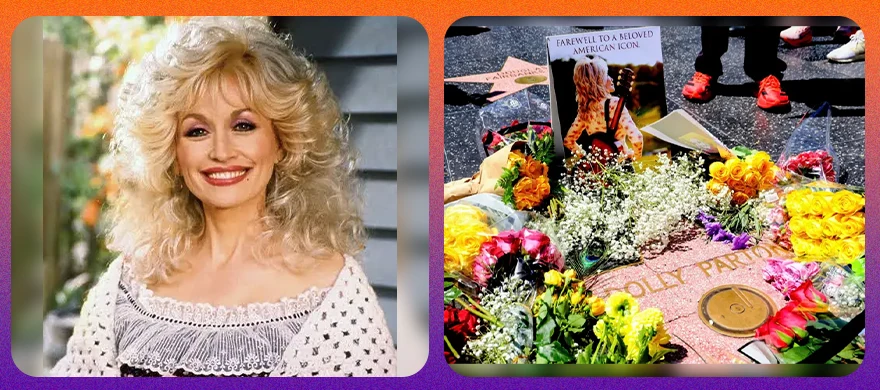
Dolly Parton died on 25th August 2026 at the age of 80. Her family and representatives confirmed she passed at the Vanderbilt-Ingram Cancer Center in Nashville after a brief battle with cancer, surrounded by loved ones.
Parton was admitted on Friday 21st August 2026. Her team stated she had bravely faced the illness. She had spoken in recent months about health issues she neglected while caring for her husband Carl Dean, who died on 3rd March 2025.
Born Dolly Rebecca Parton on 19th January 1946 in Locust Ridge, Sevier County, Tennessee, she was the fourth of 12 children in a poor farming family. Her father Robert Lee Parton worked as a tenant farmer. Her mother Avie Lee Owens Parton sang traditional ballads and hymns at home. The family lived in a one-room cabin. Parton later turned those hard beginnings into songs that millions recognised as their own story.
She wrote her first song as a small child. By age 12 she appeared on Knoxville television. At 13 she recorded for a small label and performed at the Grand Ole Opry. After high school she moved to Nashville the next day, determined to make it. Early struggles included nights spent finding leftover food, but radio and television work followed.
In 1967 she joined Porter Wagoner’s syndicated television show as the featured female singer. Their duets climbed the country charts. Parton scored her first solo number-one country hit with “Joshua” in 1971. She left the show in 1974. That year she released two of her signature songs, “Jolene” and “I Will Always Love You,” both written by her. “I Will Always Love You” served as her farewell to Wagoner. Whitney Houston’s 1992 cover turned it into a global pop phenomenon from the film The Bodyguard.
Parton crossed into mainstream pop with “Here You Come Again” in 1977. The Barry Mann and Cynthia Weil song reached number three on the Billboard Hot 100 and topped the country chart. She followed with “9 to 5” in 1980, the theme from her film debut alongside Jane Fonda and Lily Tomlin. The track hit number one on both country and pop charts. Other major hits included “Coat of Many Colors,” drawn directly from her childhood, “Islands in the Stream” with Kenny Rogers in 1983, and “Love Is Like a Butterfly.”
She sold more than 100 million records worldwide. Parton wrote more than 3,000 songs. She earned 10 competitive Grammy Awards plus a Lifetime Achievement Award in 2011. She collected multiple Country Music Association and Academy of Country Music honors. Inductions followed into the Country Music Hall of Fame in 1999, the Songwriters Hall of Fame in 2001, and the Rock & Roll Hall of Fame in 2022. She received the National Medal of Arts and Kennedy Center Honors.
Acting credits included 9 to 5, The Best Little Whorehouse in Texas and Steel Magnolias. Business ventures centred on Dollywood, the theme park she opened in 1986 near her hometown in Pigeon Forge, Tennessee. It grew into a major tourist attraction and employment source for the region.

Philanthropy defined her later decades. Through the Dollywood Foundation she launched Dolly Parton’s Imagination Library in 1995. The programme mailed free books monthly to children from birth to age five. It expanded across the United States and other countries, distributing hundreds of millions of books. She also funded medical research, including work that contributed to a COVID-19 vaccine.
Parton married Carl Thomas Dean in 1966. They remained together nearly 59 years until his death in 2025. The couple kept a private home life away from Nashville’s spotlight. Parton maintained a public image of rhinestones, big hair and sharp humour while protecting that privacy.
Her final public appearance came in June 2026 at the opening of a travel stop linked to her brand. In the weeks before her death she continued to address fans about ongoing health management while insisting she remained at work.
Parton’s catalogue continues to stream and sell. Songs such as “Jolene,” “I Will Always Love You,” “9 to 5,” “Coat of Many Colors” and “Here You Come Again” remain among the most recognised in country and popular music. Her story of rising from a Tennessee cabin to worldwide stages stands as one of the clearest examples of sustained creative and commercial success in American entertainment.