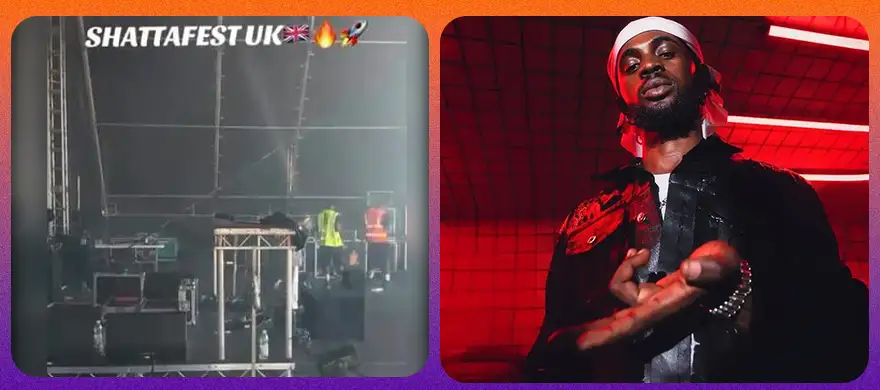
Shattafest UK organisers have pushed back on claims that the London event was completely sold out, saying
site capacity was set between 15,000 and 20,000 and that not every ticket tier was exhausted before the
cancellation. The admission came in a video interview where organising team members walked through what went
wrong - including a door-opening delay that stretched roughly five hours and a crowd-control plan that
wasn't built to handle the numbers on the ground.
That combination - inflated sold-out claims plus a thin contingency plan - is the part of this story that
hasn't gotten much attention yet, and it matters more than the fire that got blamed for the chaos.
What the organisers actually said
Doors were scheduled to open at 12:00 PM. They didn't open until somewhere between 5:00 PM and 6:00 PM, according to the organising team's own account. That's not a minor delay - that's five hours of a crowd building outside a venue with no clear communication, which is exactly the kind of pressure that turns into a crush once gates finally open.

Local council and safety officials had already flagged fire safety and crowd-control standards before the
event, which contributed to the access issues. Organisers acknowledged there was no adequate
incident-response plan in place for managing a crowd of that size once the delays started stacking up.
On the sold-out question specifically, the team pointed to official ticket allocations to argue that social
media claims of a complete sellout across every tier were inaccurate. Whether that distinction matters much
to fans who stood outside for five hours is a separate question - but it's the organisers' position, and
it's worth putting on record given how much of the online conversation has run with the sold-out framing
unchallenged.
Production was ambitious - maybe too ambitious
Before any of the chaos, the production side of Shattafest UK was being built as one of the largest setups
the event has had, according to planning discussions between organisers and Shatta Wale's team. Shatta
reportedly requested no catwalk, and the stage was expanded with LED screens and custom lighting rigs. Free
double-decker shuttle buses were arranged to move fans from nearby train stations straight to the venue.
None of that logistical ambition prevented the bottleneck at the doors. If anything, a bigger production
footprint without a matching crowd-management plan is a pattern worth flagging - scale went up, but the
safety planning underneath it didn't scale with it.
How this compares to what usually breaks first
Most festival collapses trace back to one of two things: undersold events losing money, or oversold events
losing control. Shattafest UK's organisers are now arguing it wasn't a sellout problem, which - if accurate
- points the finger squarely at execution instead: a five-hour door delay, a fire near the entrance, and a
response plan that wasn't ready for either.
That's a very different failure than the one social media ran with over the weekend, where the assumption
was simply "too many people, not enough planning." The organisers' version says the numbers weren't as
extreme as claimed, but the planning failed anyway. Both versions can't be fully true at once, and as of
August 3, 2026, no independent capacity audit has been published to settle which one is accurate.
Black Sherif, meanwhile, delivered without incident
While Shattafest UK unraveled, Black Sherif's US show in a Manhattan venue with capacity for up to 3,500
people went off cleanly. He performed cuts from The Villain I Never Was alongside Iron Boy-era fan
favourites, including "Top of the Morning," and previewed an unreleased track from an upcoming project. No
delays, no safety shutdown - a useful contrast for anyone asking whether the London chaos was a
Ghanaian-artist-touring-abroad problem or a specific execution failure on this one event.
The gap between those two nights is the story nobody's connecting yet: same weekend, same diaspora audience
appetite, completely different outcomes.