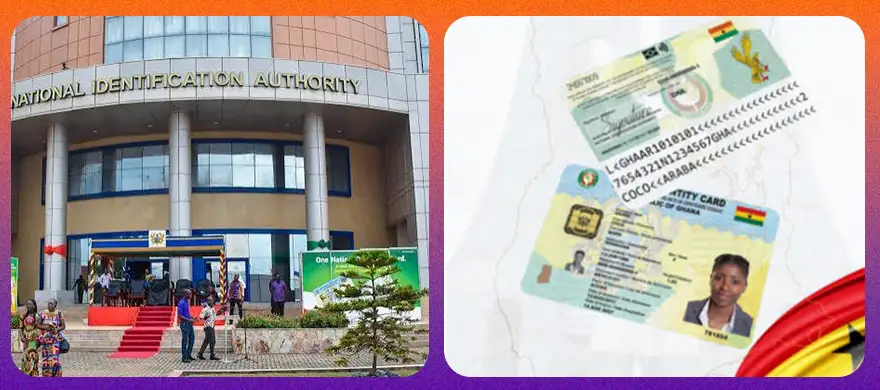
The National Identification Authority (NIA), in a statement signed by its Head of Corporate Affairs Directorate, Williams Ampomah Emmanuel Darlas, on Wednesday, 19th August 2026, said the revised Ghana Card fees now in force were approved by Parliament, not unilaterally introduced by the Authority.
The clarification came after weeks of public commentary suggesting the NIA had quietly hiked fees. The Authority said the charges were approved under the Fees and Charges (Miscellaneous Provisions) (Amendment) Regulations, 2025 (L.I. 2512), and took effect on 2nd February 2026.
What actually changed with the fees
Under the new structure, District Centre card replacement now costs GH¢200, up from the 2023 rate. Record updates without card replacement cost GH¢165 at District Centres.
Premium Centre charges range from GH¢165 for record updates to GH¢520 for card replacement. Foreign nationals pay in cedi equivalent: USD120 for first-time registration and nationality updates, and USD78 for annual renewal or replacement, according to the NIA's own published schedule.
The Authority also opened a 24-hour Prestige Registration Centre at Labone on 1st August 2026, operating under the government's 24-Hour Economy agenda. At that centre, first-time registration and renewal each cost GH¢610, while replacement costs GH¢720. The NIA has stressed the Prestige Centre is optional, not a replacement for the standard district service.
The Authority's explanation for the increase: rising costs in technology licensing, cybersecurity, logistics and personnel, which it described as largely irreversible, after operating on the 2023 fee structure for over two years.
photocopies are being phased out
Fees aren't the only shift. At a press briefing in Accra on Wednesday, 22nd July 2026, the Minister for the Interior, Muntaka Mohammed-Mubarak, announced that banks, telcos, hospitals, insurers, schools and other institutions have until 2nd November 2026 to stop requesting, retaining or reproducing photocopies of the Ghana Card.
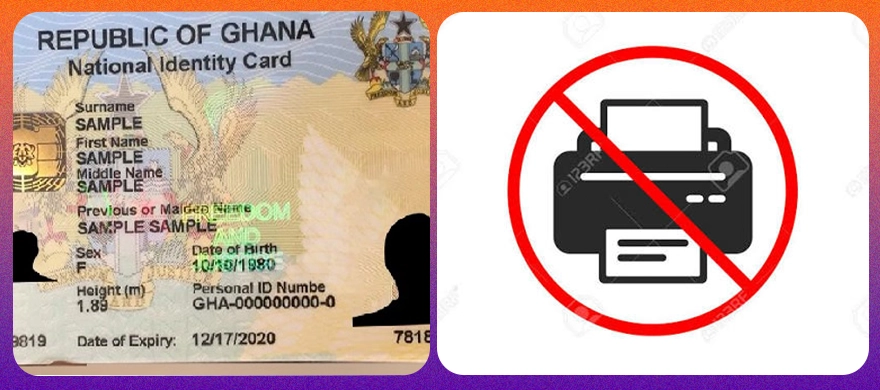
"Visual inspection alone is not verification," the Minister said, explaining the change is meant to close a gap that left photocopies sitting in filing cabinets, phones and email inboxes.
In place of photocopying, institutions must verify identity electronically against the National Identity Register or through NIA-approved match-on-card devices. This builds on a stricter Bank of Ghana directive from 8th January 2026, which already made the Ghana Card the compulsory ID for all banking transactions and tightened Know Your Customer checks.
The NIA is moving from a paper-and-verification-by-sight system toward a fully digital, fee-funded infrastructure it now openly compares to national utilities.
Frequently Asked Questions(FAQs)
Has the Ghana Card replacement fee gone up in 2026?
Yes. District Centre replacement is GH¢200, effective 2nd February 2026, per the NIA's published fee schedule approved by Parliament.
Did the NIA introduce these fees on its own?
No. The Authority says the fees were approved under L.I. 2512 and were not a unilateral decision, according to its 19th August 2026 statement.
When must banks and hospitals stop taking Ghana Card photocopies?
By 2nd November 2026, per the Interior Minister's 22nd July 2026 announcement.
Is the Prestige Centre at Labone mandatory?
No. The NIA has confirmed it is an optional, faster service alongside standard district registration.
What should I do if my bank still asks for a photocopy after November?
The NIA has directed the public to raise concerns through its official channels; the Authority has not yet detailed a penalty process for non-compliant institutions.