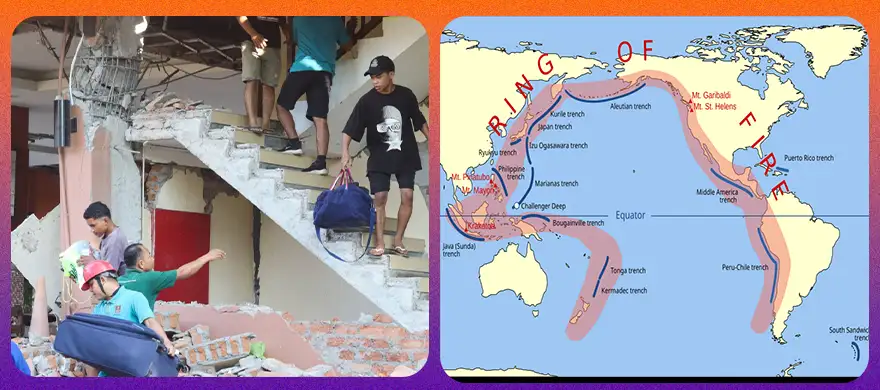
Four powerful earthquakes struck within just over two months, all along the same seismic belt. A magnitude 7.4 hit western Colombia on August 10th, 2026. A magnitude 6.8 struck southern Japan on July 28th, 2026. A magnitude 7.3 shook the Pacific coast of southern Mexico on July 17th, 2026. And a magnitude 7.8 hit the southern Philippines on June 8th, 2026. They sit thousands of kilometres apart, yet every one falls on the Pacific Ring of Fire.
This horseshoe-shaped belt of tectonic plate boundaries circles much of the Pacific Ocean. In many places one plate is forced under another. Plates lock, pressure builds, then slips and releases energy as an earthquake. Roughly 81 percent of the world’s largest earthquakes occur along this zone. The recent cluster is a reminder of how active the region already is, not proof of a sudden increase.
Large quakes can send seismic waves that trigger smaller tremors far away. No evidence links these four events into one chain reaction. The Ring of Fire produces strong earthquakes year after year. These four simply arrived close together in calendar time while remaining separate in location and mechanism.
What the Ring of Fire Actually Does
Tectonic plates grind and collide around the Pacific. Subduction zones dominate, where denser ocean crust dives under lighter continental crust. That process creates both deep and shallow earthquakes plus the volcanoes that give the belt its name. Japan, the Philippines, Mexico’s Pacific coast and Colombia’s western edge all sit on active segments of the same system.
The June 8th Philippines quake ruptured along the Cotabato Trench. The July 17th Mexico event occurred where the Cocos plate subducts beneath North America. The July 28th Japan quake was a shallow strike-slip event on a crustal fault in Kyushu. The August 10th Colombia quake involved intermediate-depth faulting within the Nazca plate as it sinks under South America. Different fault types, different depths, same broad belt.
Why the Cluster Feels Alarming but Fits the Pattern
People notice clusters more than isolated events. Social media and 24-hour news amplify the pattern. Historical records show the Ring of Fire regularly delivers multiple magnitude 7-plus events in short windows. The zone stretches more than 40,000 kilometres and hosts hundreds of active volcanoes and fault systems. Random timing can produce four strong quakes in two months without any underlying change in plate motion rates.
Scientists monitor strain accumulation with GPS networks and seismometers. No data as of August 15th, 2026 points to a region-wide acceleration. Individual segments can unlock after long quiet periods, but that is local, not belt-wide.
Ghanaian audiences rarely see direct links between distant Pacific events and West African reality. The last major West African earthquake of note was the 1939 Accra event. West Africa sits far from the Ring of Fire, yet the same plate tectonics that drive Pacific subduction also shape the African continent’s slower, less dramatic movements. The recent Pacific sequence shows how energy stored over decades or centuries can release in rapid succession once a critical threshold is crossed. That principle applies everywhere plates meet, even if Ghana’s risk remains far lower.
The unanswered question is whether public communication about seismic clusters needs clearer language. Headlines that list four big quakes in two months without stressing the lack of connection can fuel unnecessary anxiety. Clear separation of coincidence from causation would serve readers better.
The four earthquakes remain independent events on the planet’s most active seismic belt. They illustrate the constant motion under the Pacific, not a sudden shift in that motion.
Frequently Asked Questions(FAQs)
Is the Pacific Ring of Fire becoming more active after these four quakes?
No. The zone already produces the majority of the world’s large earthquakes. These four events fit long-term patterns rather than signalling a change.
Could one of these earthquakes have triggered the others?
Seismic waves can sometimes trigger distant smaller tremors, but no evidence connects these four as a single chain reaction.
Which countries sit on the Ring of Fire?
Countries bordering the Pacific including Japan, the Philippines, Indonesia, New Zealand, Chile, Peru, Mexico, the western United States, Canada, Russia and parts of Central America.
How often do magnitude 7 or larger quakes hit the Ring of Fire?
They occur regularly. Multiple magnitude 7-plus events in a single year are common across the full length of the belt.
Does Ghana face similar earthquake risk?
West Africa sits far from the Ring of Fire. Seismic risk is much lower, though minor tremors can still occur.