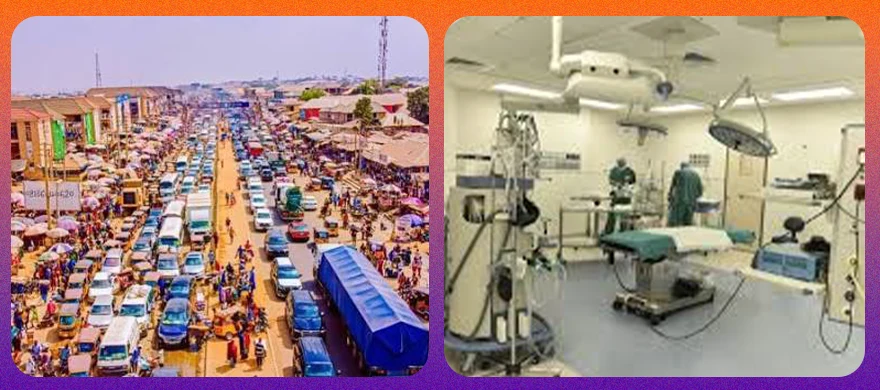
Nigeria has a working, documented market for human kidneys, and it isn't hiding in some dark corner of the internet. It runs through real hospitals, real "agents," and a going rate that has stayed roughly the same for years: about ₦1 million per kidney, according to a three-month undercover investigation by Daily Trust on Sunday published on 10th December 2023.
Lagos and Abuja are two of the closest, cheapest places for cross-border medical care in West Africa, and transplant tourism doesn't stop at a border checkpoint. If a hospital isn't asking hard questions about where a "donor" came from, it isn't asking harder questions about where the recipient came from either.
The ₦1 Million Kidney: Daily Trust's Mararaba Investigation
Yahuza's kidney was harvested at a private hospital in Abuja and given to a waiting patient. He was paid ₦1 million - half of what he expected, after two associates allegedly took a cut. He told Daily Trust he had since lost the strength to do manual work and had briefly considered suicide.
He wasn't tricked by a stranger - he was routed through his own cousin, to an agent his cousin already trusted, into a hospital that asked for a blood sample and moved fast. Every checkpoint that should have caught this instead passed him along.
The investigation also named Abbas's brother, Habib, as someone who had separately sold a kidney, and traced the local agent network back to a Lagos-based broker. Daily Trust reported that the case of Oluwatobi Adedoyin, a 16-year-old lured into selling his kidney by an acquaintance in August 2023, first exposed Alliance Hospital in Garki, Abuja, which has since faced accusations of harvesting kidneys from at least three minors. Those accusations remain allegations; no criminal conviction against the hospital had been reported as of 24th August 2026.
When It Crossed Into an International Court
The case that put Nigeria's organ trade on the world's radar wasn't from Mararaba. It was a former Deputy Senate President. Ike Ekweremadu, his wife Beatrice, and UK-based doctor Obinna Obeta were convicted at London's Old Bailey on 23rd March 2023 of conspiring to traffic a 21-year-old Lagos street trader to Britain to harvest his kidney for their daughter, Sonia, who needed a transplant. The victim was allegedly offered up to £7,000 and told he was travelling for work; prosecutors said he only realised the real plan once he was in front of British doctors and refused to consent, according to the Crown Prosecution Service.
On 5th May 2023, Justice Jeremy Johnson sentenced Ekweremadu to nine years and eight months, Beatrice to four years and six months, and Obeta to ten years - the first convictions of their kind under the UK's Modern Slavery Act 2015. Sonia was cleared by the jury. As of November 2025, Nigerian officials confirmed they were pursuing a prisoner-transfer arrangement to have Ekweremadu serve the rest of his term at home, Daily Trust reported - a request still under discussion as of 24th August 2026.
Ekweremadu's family allegedly offered thousands of pounds sterling; Mararaba's agents pay in naira that barely covers rent. The wealth gap changes the currency, not the transaction.
What Nigerian Law Says About This
The National Health Act of 2014 governs organ donation and explicitly bars payment for organs. The problem, medical experts told Daily Trust, is enforcement, not legislation.
A professor identified only as Prof Abdu told the paper that international guidelines already exist, pointing to the WHO's Istanbul Declaration, which Nigeria is a signatory to. Despite that framework, Daily Trust's investigation found that neither the Nigerian Medical Association nor the Nigerian Medical and Dental Council had sanctioned any hospital linked to illegal transplants as of the report's publication.
Frequently Asked Questions(FAQs)
Is organ harvesting legal in Nigeria?
No. The National Health Act 2014 prohibits the sale of human organs. Altruistic donation between consenting parties, with proper consent and screening, remains legal.
How much does a kidney sell for on Nigeria's black market?
Daily Trust's investigation put the going local rate at around ₦1 million, paid mostly to donors from low-income backgrounds in satellite towns like Mararaba.
What happened to Ike Ekweremadu?
He was convicted on 23rd March 2023 and sentenced on 5th May 2023 to nine years and eight months in a UK prison. As of November 2025, Nigerian authorities were reportedly seeking his transfer to serve out his term at home; no transfer had been confirmed as of 24th August 2026.
Has any Nigerian hospital been shut down over illegal transplants?
Not as of the most recent reporting (August 2026). Alliance Hospital in Garki, Abuja, has faced public accusations tied to at least three minors, but these remain unproven allegations, and no licence action has been publicly confirmed.
Where can someone report a suspected organ-trafficking case in Nigeria?
Cases can be reported to the Nigeria Police Force or Nigeria's National Agency for the Prohibition of Trafficking in Persons (NAPTIP), which handles trafficking-related offences including organ trafficking.