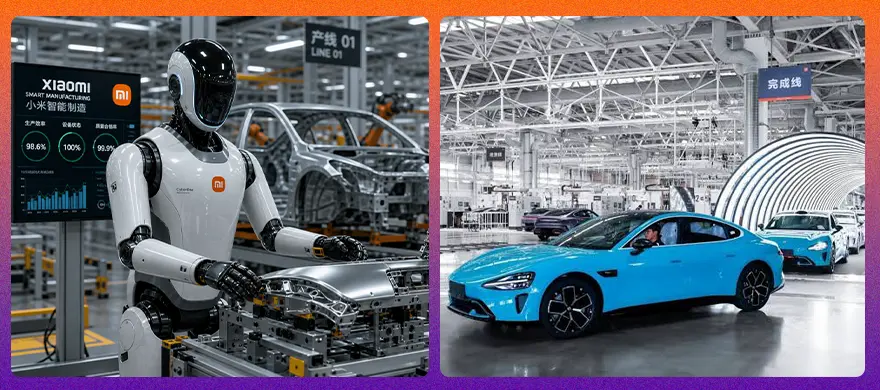
Xiaomi’s Beijing electric vehicle factory turns out a finished car every 76 seconds at full capacity. That works out to roughly 40 vehicles per hour. The plant, which spans about 720,000 square metres, relies on more than 700 robots and advanced AI systems for most of the work.
Xiaomi, the same Chinese company known for affordable smartphones, smartwatches and earbuds, announced its move into cars four years earlier. The factory itself was built from scratch in 14 months. As of late 2025 and into 2026 the facility has supported cumulative deliveries that crossed 600,000 vehicles. One of its newer models, the YU7 SUV, drew 200,000 orders in the first three minutes after sales opened.
Inside the hyperfactory
The production line runs with high automation levels. Body-shop and paint-shop processes reach around 90 percent automation in key areas. Robotic arms handle door installation, windshield fitting and other precise tasks. From part pickup to installation on the body, some steps finish in under 30 seconds. The paint shop can switch colours in about 40 minutes.
An AI-powered inspection system, often referred to in company materials as part of Xiaomi’s smart quality control, checks vehicles with claimed accuracy above 99.9 percent on critical defects. Robots continue operating through the night in areas that do not require lighting, cutting energy use. Humanoid robots from Xiaomi’s own CyberOne line have been tested on specific stations such as nut installation. Early trials showed success rates around 90 percent while matching the 76-second line pace; later updates pushed some tasks higher.
The 76-second figure is the interval between completed vehicles leaving the line at peak rate. It does not mean one car is built from raw metal to finished product in that time. Traditional assembly still involves multiple sequential stations. The speed comes from tight coordination, large-scale die-casting that reduces the number of parts, and minimal human intervention on repetitive work.

From phone maker to car producer
Xiaomi launched its first EV, the SU7 sedan, in March 2024. Deliveries began days later. Demand stayed strong. Cumulative deliveries reached 600,000 by February 2026, 22 months after the first customer cars went out. The company set a 2026 delivery target of 550,000 units and continues expanding capacity, including additional phases in Beijing and a new plant in Wuhan.
The factory’s rapid construction and high robot count reflect Xiaomi’s electronics manufacturing background. Processes that work for smartphones—tight supply chains, heavy automation, real-time data monitoring—were adapted to vehicle production. Large die-casting machines consolidate dozens of separate parts into single structural pieces, simplifying assembly and improving body strength.
Traditional carmakers such as Toyota, Volkswagen and Ford have decades of experience and global scale. Xiaomi’s approach shows how a technology company can enter the industry with heavy capital, vertical integration and AI-driven efficiency. The result is a production cadence that matches or exceeds many established plants when running at full capacity.
What this means for jobs and industry
High automation reduces the number of workers needed on the line for repetitive tasks. Xiaomi still employs people for supervision, maintenance, quality oversight and complex problem-solving. The company has described humanoid robots as “interns” in early trials rather than full replacements. Over the next several years Xiaomi plans wider deployment of its own humanoid systems inside its factories.
For countries that import vehicles or host assembly plants, the model raises clear questions about competitiveness. Factories that combine robotics, AI inspection and rapid colour and model changeovers can respond faster to demand shifts. Ghana and other African markets already see growing numbers of Chinese EVs. Lower production costs and high output volumes help explain the price positioning of models such as the SU7 against established rivals.
Frequently Asked Questions(FAQs)
How fast does Xiaomi actually build a car?
At full capacity the Beijing plant completes one vehicle every 76 seconds. That is the line rate, not the total build time for a single unit from start to finish.
How big is the factory?
Approximately 720,000 square metres, roughly the size of 100 football fields.
How many robots work there?
More than 700 industrial robots handle body assembly, painting, installation and inspection tasks. Humanoid robots have been tested on selected stations.
Has Xiaomi delivered many cars yet?
Yes. Cumulative deliveries passed 600,000 by February 2026. The YU7 SUV alone recorded 200,000 orders in its first three minutes of sales.
Is the factory fully AI-run with no people?
No. Automation is high, especially in body and paint shops, but humans remain for supervision, maintenance and certain quality roles. Robots enable continuous operation in low-light conditions.
When did Xiaomi start making cars?
The company publicly entered the EV business several years earlier. The first model, the SU7, launched in March 2024 and deliveries began shortly afterward. The main Beijing factory was completed in about 14 months.