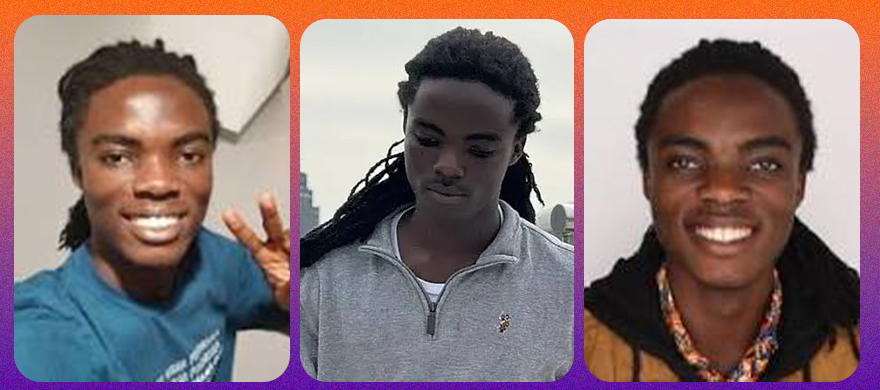
Some people are crushed by their obstacles, but others use them to their advantage and Tyrone Iras Marhguy
is one of them. I was lucky to see him on campus during my days at Achimota School. He was the kind of
person who carried himself with quiet confidence and an unmistakable brilliance.
I kept wondering to myself why he still decided to join the National Science & Maths Quiz after the lawsuit
he had filed against the school for infringing on his right to practise his religion. But then I realised he
wanted to show the world what he had in him, and nothing was going to stop him.
The Dreadlocks Lawsuit That Started It All
Let's go back to 2021. Tyrone Marhguy had just gained admission to Achimota Senior High School. Dream come
true, right?
Well, one look at him and the school said no. Not because of his grades. Not because of his conduct. But
because he was a Rastafarian and his faith required him to keep his hair. Achimota School considered this a
dress code violation and told him to cut his hair if he wanted to take up his admission.
That ultimatum is what drove Tyrone and his father to court. The school was essentially asking them to
abandon their religion just to access education.
The case was heard at the Human Rights Division of the Accra High Court, where Justice Gifty Adjei Addo
ruled in Marhguy's favour on May 31, 2021. The verdict was clear:
No student in Ghana should be denied an education because of their religious beliefs.
Achimota School was ordered to admit him.
This wasn't just a win for Tyrone it cleared the path for every Rastafarian student to be free from that
kind of discrimination.
His Achievements at Achimota and Beyond
You might expect that after winning a high-profile court battle and navigating that kind of scrutiny at 16,
Tyrone would keep his head down and quietly get through school. But his confidence was unmatched. I
personally saw him around campus with friends, completely unbothered, living his life.
By the time the 2023 WASSCE results came out, Marhguy had earned eight A1s — the highest possible grade in
the WASSCE grading system. He went on to win a gold medal at the American Mathematics Olympiad, competing
against students from across the world.
That combination of academic excellence and international recognition set the foundation for him to earn a
full scholarship to study Computer Engineering at the University of Pennsylvania, one of the Ivy League
universities in the United States and a world-renowned engineering school.
The ALU Project and Why It Deserves to Be Talked About
Most Computer Engineering students learn how chips work through textbooks and simulations. They understand
the theory, they run the code, and they move on. READ ALSO He didn't let a single "no" define his life. Many people would have walked away given the obstacles he
faced. Instead, he fought the system and made a name for himself in the very institution that once denied
him entry. He excelled academically, competed for that same school, and earned a scholarship that most
students only dream about.
Tyrone went several layers deeper. He didn't just understand the logic he understood the physics. He reached
the point where he could mentally trace the path of individual electrons through his circuits, a level of
intuitive understanding that many engineers never develop, even after years in the field.
In January 2026, at 22 years old and still a student at UPenn, he built a working 8-bit Arithmetic Logic
Unit (ALU) , essentially the computational brain of a computer in his dorm room.
let's put this in perspective.
An ALU is the part of a computer's processor that handles all the math and logic: additions, comparisons,
decisions. It's what makes a computer actually *compute*. Modern chips pack billions of transistors into a
sliver of silicon the size of your thumbnail, produced inside fabrication plants that cost billions of
dollars to build and operate.
Tyrone built his by hand. One transistor at a time.
His ALU used 3,488 transistors in total, including 624 MOSFETs he soldered manually. The finished circuit
can execute 19 different operations, handles 8-bit words, and tracks 7 status flags, all the hallmarks of a
proper, functional processor. To verify it worked correctly, he ran 1.24 million test vectors across more
than 250 hours of building and testing. That's not just building something interesting. That's real
engineering rigour.
Next on his list: improving the chip's performance, completing the soldering, and working through any
remaining bugs. You can explore his work at alu.tmarhguy.com
What Tyrone's Story Tells Us
Tyrone is proof that no one can break your spirit but you. It's not what people do to you it's how you
choose to respond to it. You can achieve whatever you put your mind to. Obstacles are a constant in life,
and just like the good things, we have to face them, challenge them, and learn from them. They shouldn't
define you. They shouldn't redirect your dreams. All you truly have is your spirit protect it.