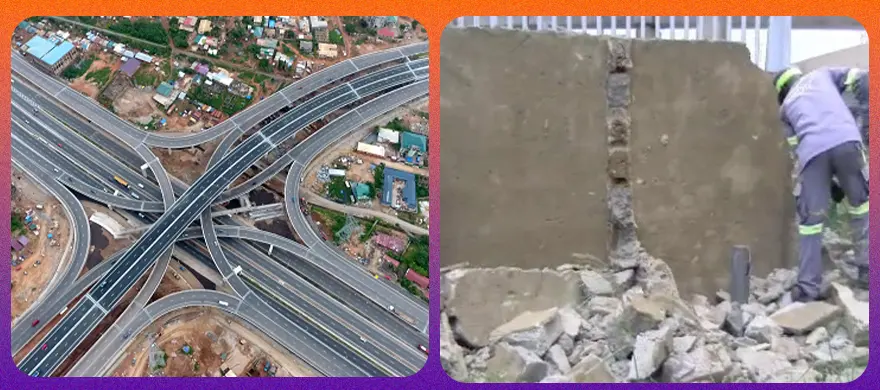
Ga North Municipal Chief Executive Akwetey Agbo has confirmed that the public toilet facility under
construction beneath the Pokuase Interchange on the Accra-Kumasi Highway has been demolished. The Ga North
Environmental Health and Sanitation Department carried out the demolition after the structure was found to
have been built at an unapproved location.
The Assembly had awarded the project to address sanitation needs around the interchange. The approved site
was different. Work started, but within about three days the contractor shifted to the secluded spot under
the interchange. Officials halted the project roughly six months ago once the deviation was noticed. The
incomplete structure remained until public pressure and viral videos forced the final demolition on August
4, 2026.
Agbo told Citi News the facility was never meant for that exact position under the flyover. “We halted the
project over six months ago. Barely three days after work started, we realised the contractor had moved away
from the approved site, so we stopped the construction,” he said. The structure has since been pulled down.
Why the project started in the first place
Agbo earlier explained to JoyNews that the Assembly initiated the toilet as part of a wider plan to decongest Pokuase Junction. Commercial vehicles regularly load along the roadside, choking the area for motorists and pedestrians. The idea was to move operators into designated spaces under the interchange and provide basic amenities, including toilets, for them and for commuters. He stressed the genuine sanitation gap. People working and trading around the enclave often resort to nearby bushes because no proper public facility exists.
“If you look at the whole enclave, we actually need such a facility because people, especially those who operate businesses around the area, use the nearby bushes as a place of convenience. We need to address that,”
Agbo said.
The Pokuase Interchange itself is West Africa’s largest four-level stack interchange. Completed and commissioned in 2021, it carries heavy daily traffic on the Nsawam Road corridor. Placing any permanent structure underneath raises immediate questions about structural safety, access for maintenance crews, drainage, and emergency response.
Public backlash and the ownership confusion
Viral videos of the incomplete toilet under the interchange sparked days of debate. Many assumed a private
individual was building it for commercial gain. Agbo initially pushed back hard, insisting it was an
Assembly project, not a private development. He framed it as a practical response to congestion and open
defecation.
Residents raised separate concerns. The abandoned structure had become overgrown and unsafe. Reports of
vehicles near the site added to the unease. Once the wrong-location fact became clear, the Environmental
Health and Sanitation Department moved in and demolished what remained.
The sequence left an unfinished concrete shell sitting under a major national road asset for months. That
alone turned a sanitation plan into a public relations problem for the Assembly.
What remains unresolved
As of August 5, 2026, Agbo has not announced a new timeline or a confirmed alternative site for a
replacement toilet. The Assembly still acknowledges the need. Open defecation around the junction continues.
Transport operators still load on the roadside. The decongestion plan that justified the original project
has not moved forward in any public way.
The episode highlights a recurring tension in Accra’s rapidly expanding road network. Interchanges create
large under-spaces that look available for informal use, yet those spaces sit under engineered structures
that were never designed for permanent buildings. Contractor deviations, delayed enforcement, and weak site
supervision turned a straightforward sanitation contract into a demolition.
The Ga North Municipal Assembly has cleared the site. The next step rests with the same authority that
approved the original contract and then had to reverse it. Whether a properly located public toilet
eventually appears, and whether the transport operators ever leave the roadside, will show if the lesson
from the demolished structure was absorbed.