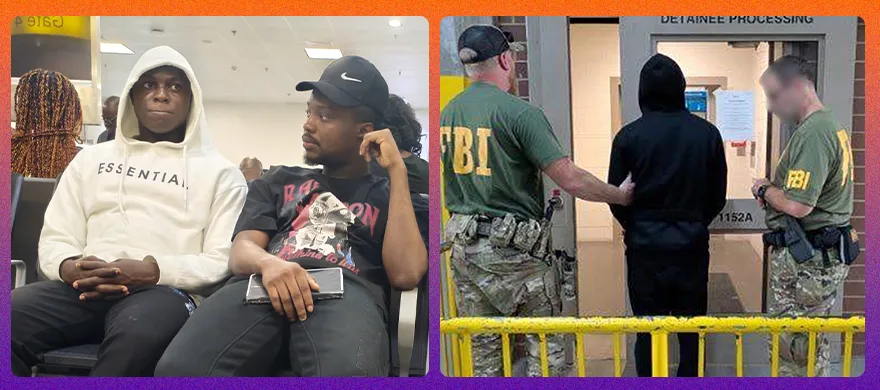
The Economic and Financial Crimes Commission handed over Adebola Festus Adekunle, 26, of Lagos, and Mudasiru Afeez Olawale, 24, to United States authorities on 26th August 2026. The two men face federal charges in separate cases of financially motivated sextortion of American minors that prosecutors link to the deaths of teenagers in Mississippi and North Carolina.
The US Department of Justice announced the extraditions on 28th August 2026. Both men were arrested in Nigeria in August 2023 during a wider FBI operation targeting sexual extortionists. They appeared in federal courts the following day—Adekunle in Oxford, Mississippi, and Olawale in Greensboro, North Carolina. All charges remain allegations. The defendants are presumed innocent unless proven guilty in court.
How the Mississippi Case Unfolded
Prosecutors charge Adekunle with sexual exploitation of a minor resulting in death, production of child sexual abuse material, coercion and enticement of a minor, and interstate threats with intent to extort. The case centres on 16-year-old Walker Montgomery of Starkville, Mississippi, who died by suicide on 1st December 2022.
Court records state that on 28th November 2022 an Instagram account posing as a 19-year-old female contacted Montgomery. The account asked him to produce images for a “nude exchange.” Montgomery sent sexually explicit material. The account then used that material to demand money and threaten to send the images to his friends and family. When Montgomery said he would kill himself, the response according to the indictment was “okay.” He was found the next morning with a fatal self-inflicted gunshot wound.
Adekunle faces a maximum of life in prison. The charge of sexual exploitation of a minor resulting in death carries a mandatory minimum of 30 years.

North Carolina Charges
Olawale faces charges relating to the sexual exploitation of minors resulting in death, enticement of minors, interstate threatening communications, and distribution of child pornography. Prosecutors say he was involved in the financially motivated sextortion of one minor and the sextortion and death of another in North Carolina. He also faces a maximum of life in prison and mandatory minimum sentences on at least two counts.
How the Schemes Operated
According to the EFCC and US authorities, the alleged schemes followed a consistent pattern. Suspects contacted teenage boys, mostly aged 13 to 17, on Instagram or similar platforms. They posed as peers or romantic interests and persuaded the victims to share nude images or participate in video chats that were recorded. Once the material was obtained, the suspects threatened to distribute it to the victims’ contacts, family and schools unless money was paid.
Payments were demanded through money-transfer services, gift cards and cryptocurrency. In the Mississippi case the demand was $1,000. Communications sometimes continued even after victims expressed suicidal intentions. The FBI and EFCC describe these as financially motivated operations rather than isolated acts.
EFCC Role and Legal Process
EFCC spokesperson Dele Oyewale stated that the Lagos Zonal Directorate 2 facilitated the handover after the FBI identified the two men in separate investigations. Adekunle was arrested following the EFCC probe. Olawale’s extradition required a longer process. A Federal High Court initially refused the application, but the Court of Appeal in Lagos set aside that ruling on 7th July 2026, clearing the way for his transfer.
The extraditions form part of Operation Artemis, the FBI’s focused effort against financially motivated sextortion networks linked to Nigeria. The Justice Department has noted that such schemes have been connected to dozens of American teen suicides. Nigerian authorities, including the Attorney General of the Federation and the EFCC, provided essential support in locating, arresting and transferring the suspects.
As of 30th August 2026 both men remain in US custody pending further proceedings. Prosecutors in Mississippi and North Carolina will continue building their cases. The US Department of Justice and the FBI have stated they will keep pursuing similar international networks.
The cases underline the cross-border reach of online extortion that begins on social media platforms popular with young people. Victims are pressured into producing explicit material and then blackmailed for money. When the demands continue and the threats feel inescapable, the consequences can be fatal. Law-enforcement agencies on both sides of the Atlantic now treat these as priority matters requiring sustained cooperation.