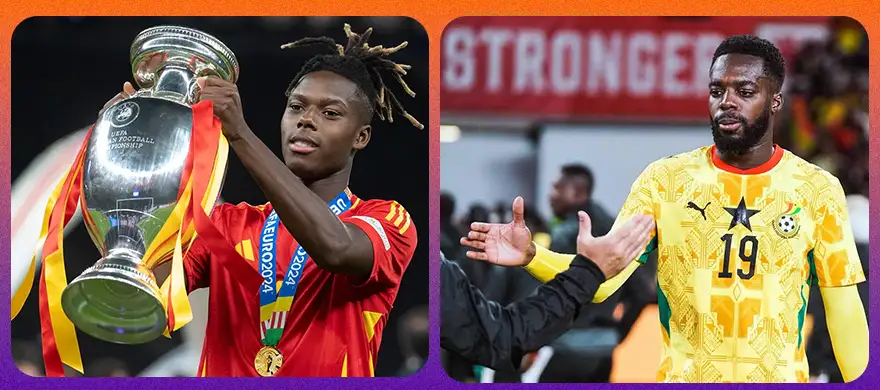
Iñaki and Nico Williams did not play for the same country at the 2026 World Cup. That's the correction worth making before anything else, because it's the detail most casual headlines blur. Nico wore Spain's shirt and lifted the trophy on July 19, scoring the assist that beat Argentina 1-0 in extra time. Iñaki wore Ghana's, started two matches for the Black Stars, and watched his tournament end in the Round of 32 against Colombia.
One brother's Ghanaian heritage built a Black Stars career. The other's Spanish upbringing built a World Cup medal. Same parents, same club - Athletic Bilbao - completely different shirts on the biggest stage in football. That split is the whole story, and it's why Ghanaian football fans spent June and July arguing about it on Twitter and TikTok.
How two brothers ended up on opposite sides
Félix and María Williams left Ghana for Spain in 1994, reportedly making part of the journey on foot through the Sahara before settling in the Basque Country. María was pregnant with Iñaki during that trek; Nico was born later, already in Spain. Both boys grew up eligible for either nation under FIFA rules, since their parents held Ghanaian nationality and the family lived in Spain.
Iñaki actually wore Spain's colours first. He earned a senior cap under Vicente del Bosque in a 2016 friendly, but the call-ups dried up after that. In 2022, following a trip home to Ghana and what he later described to BBC Sport Africa as a decision shaped by his 90-year-old grandfather's wish to see him at a World Cup, Iñaki completed a one-time switch to the Black Stars. Under FIFA regulation, that switch is final - there is no route back to Spain for him now, whatever social media speculation says.
Nico took the opposite path. He progressed through Spain's youth ranks, debuted for La Roja at 18 in 2022, and by 2026 had become one of the side's most important attackers, arriving at the World Cup as a reigning Euro 2024 winner.
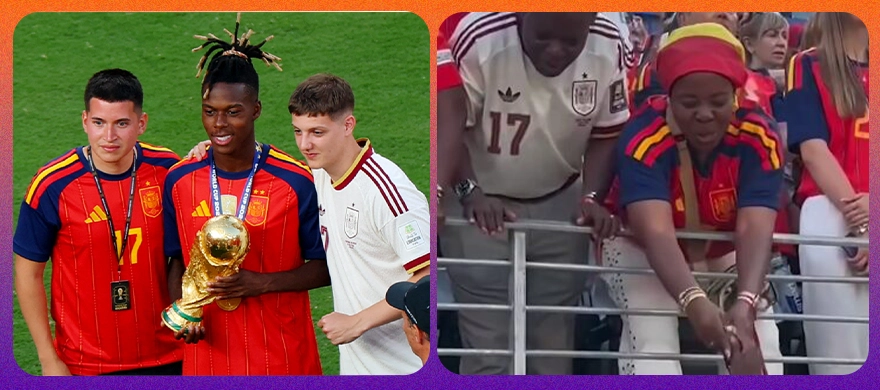
Nico's tournament: from bench to history
Nico made six appearances across Spain's triumphant campaign. In the final against Argentina, he came off the bench and set up Ferran Torres for the 106th-minute winner that snapped Argentina's 13-match World Cup unbeaten run. It was, by most measures, the peak moment of his career so far.
Iñaki's tournament: proud exit, no goals
Ghana finished third in a brutal Group L - England, Croatia and Panama - but advanced anyway as one of the tournament's best third-placed sides, their first knockout-stage appearance since 2010. Iñaki started the goalless draw with England and the Round-of-32 defeat to Colombia, where Jhon Arias' first-half strike ended the Black Stars' run. He didn't score in either game. On X after the elimination, he thanked the country and promised a comeback, writing that the whole nation had come together behind the team again.
The pride-and-identity conversation
When Spain won, Iñaki - a Ghana international, remember, not a Spain one - posted a tribute calling his brother's triumph a win for immigrant families everywhere, not only a football result. Ghanaian commentary split roughly two ways. One camp treated Iñaki's choice as a quiet source of pride: a Black Stars captain-calibre forward who turned down Spain's second-choice treatment to build something with Ghana, at real cost to his own trophy chances. The other camp pointed at Nico's World Cup medal and asked, only half-jokingly, whether Ghana lost the "better" Williams brother by not moving fast enough back in 2016.
Iñaki has been explicit that Nico never had the choice he did - Nico's opportunity with Spain came at 18; his own chance with Ghana came at 28, after Spain had already frozen him out. It wasn't a straight sibling rivalry over which flag was "better." It was two different footballing paths that happened to land in the same delivery room years apart.
Most of the wire pieces on this stop at "two brothers, two countries, isn't that quirky.". Kevin-Prince and Jérôme Boateng at the 2010 World Cup, who actually faced off on the pitch - Ghana against Germany, brother against brother, in the same group stage. The Williams brothers never got that head-to-head moment in 2026, since Spain and Ghana sat in separate groups and neither side's knockout run crossed the other's. That's arguably the more interesting question nobody's asked yet: what happens the next time a major tournament draw puts a Ghana-eligible Williams generation in the same group as Spain? It hasn't happened yet with these two, and now, with Iñaki's switch permanently locked in and Nico establishing himself as a Spain regular, it may never happen at senior level for this pair specifically.
during the tournament
Two rumours went viral in Ghana during the World Cup and both needed knocking down. The first claimed Iñaki was in talks to switch back to Spain after Ghana's exit - not possible under FIFA's one-time-switch rule, and Iñaki never suggested it. The second claimed Nico was being courted by the Ghana Football Association for a future switch of his own - there is no confirmed reporting from GFA, Nico's camp, or Athletic Bilbao supporting that claim, and it should be treated as unverified as of August 2, 2026. Filladey Media held off publishing either until there was something to confirm, which is the whole point of checking before sharing.
Did Iñaki Williams play for Spain at the 2026 World Cup?
No. Iñaki has represented Ghana since his 2022 switch and played for the Black Stars throughout the 2026 tournament, including the Round-of-32 exit to Colombia.
Why didn't Iñaki Williams stay with Spain?
He was capped once by Spain in 2016 but wasn't called up again for years. In 2022, he completed a one-time nationality switch to Ghana, a decision he's linked to a promise made to his grandfather.
Can Iñaki Williams still switch back to Spain?
No. FIFA's one-time-switch rule is final once used, so Iñaki's international future is tied to Ghana going forward.
Did Nico Williams ever consider playing for Ghana?
There's no confirmed statement from Nico, his representatives, or the Ghana Football Association indicating he considered it. Any claim otherwise circulating online is unverified as of August 2, 2026.
How far did Ghana go at the 2026 World Cup?
Ghana finished third in Group L, advanced as one of the best third-placed teams, and were eliminated by Colombia 1-0 in the Round of 32 — their first knockout-stage appearance since 2010.