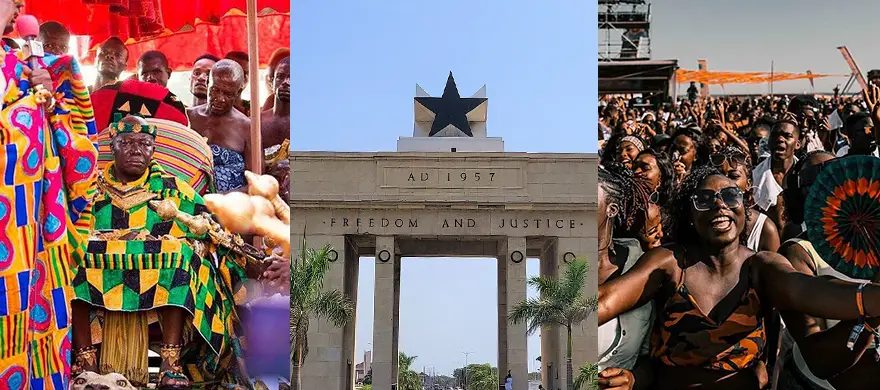
Ghana is home to roughly 36 million people, grouped into more than 50 ethnic groups who speak around 80 different languages. If you have been to Ghana before, you have probably seen a large sign reading "Akwaaba", the Akan word for welcome. The Gas say "Obaake", the Ewes say "Wiezor" and the Dagombas say "Maraaba".
You are welcome to join Filla Dey as we unpack the cultural diversity of Ghanaians and fascinate you with it.
Ghana at a Glance
According to the 2021 Population and Housing Census, the Akan remain Ghana's largest ethnic group, making up 45.7% of the population. They are followed by the Mole-Dagbani at 18.5%, the Ewe at 12.8%, the Ga-Dangme at 7.1%, and the Gurma at 6.4%. The Guan account for 3.2%, while all other ethnic groups combined make up the remaining 6.3%.
English, however, is the official language of government, education and business. Most Ghanaians speak at least two languages, and many speak three or four. This is not really a surprise in our capital, Accra, where people from different parts of the country arrive to work year in and year out.
Twi is the most common language among the Akan. It is spoken in the Ahafo, Ashanti, Bono, Bono East and Eastern regions, and many closely related varieties exist within the wider Twi family.
Fante, another Akan language, is the main alternative. It is spoken in the Western, Western North and Central regions.
In the Volta and Oti regions, the common languages are Ewe and Guan, while Ga is the main language of the Greater Accra Region.
In the north, which covers the Northern, North East, Savannah, Upper East and Upper West regions, Mole-Dagbani languages such as Dagbani are widely spoken. Tamale, in the Northern Region, is the major hub.
Etiquette for Visitors
When visiting Ghana, make sure to use your right hand for greeting, giving, receiving and eating. The left hand is considered impolite in many settings.
Greet people before asking for anything, and greet elders first. This can be just a good morning, good afternoon or good evening, depending on the time of day.
Dress modestly at chiefs' palaces, funerals and religious events. Funerals are major social occasions, often marked by black or red cloth.
Ask locals or tour guides before photographing people, ceremonies or shrines. Also follow local guidance at festivals, since some rituals are closed to outsiders.
Bring a small gift if you are invited to a home or a chief's palace. Drinks are usually a smart choice
Coming to Ghana? Things You Need to Know
What should you pack?
Ghana has a warm tropical climate all year round, so pack something light and breathable, plus sunscreen and sunglasses. Bring some beachwear too. I 100% recommend visiting a beach resort in Ghana and getting yourself some kebab there, but I digress.
The heavy rainy season runs from around April to July. It also rains in September and October, though lightly in Accra. Do add a jacket if you are visiting within those months.
You can also buy nice African prints and clothes here for your visits to chiefs' palaces and cultural sites.
How do I change my money?
ATMs work everywhere, from Accra International Airport to any area within Accra, anytime you touch down. If you are using an international Visa or Mastercard, you can simply withdraw your money in Ghana cedis. You can also exchange cash, say dollars or any other foreign currency, at licensed forex bureaus. Please avoid street changers.
MTN Mobile Money is also widely used, but registering for it as a visitor is really difficult.
Getting around
Use Uber or Bolt, or a pre-arranged hotel pickup. Official airport taxis are also an option, but confirm the price first.
Is the internet reliable? How do I get a SIM?
Mobile data is good in cities and patchy in remote areas. Buy a SIM from MTN, Telecel or AT at the airport or an official shop, and bring your passport.
Accommodation
Airbnbs work in Ghana too. You can book an apartment as you would anywhere else in the world, with prices starting at 1,000 cedis per night. If it is just a short stay and you want to relax, you can also book rooms in advance on the websites of hotels and resorts.
What is the tipping culture in Ghana?
Tipping isn't mandatory. If you need an extra favour from a driver or a guide and it costs them time and fuel, you can consider tipping. Ride-hailing apps usually charge according to how long you stay in the car, so you will probably be paying for that time already. In the end, it is up to you.
Where are good hospitals and pharmacies? Do I need travel insurance?
The best private hospitals and pharmacies are in Accra and Kumasi. Yes, get travel insurance with medical cover. Take malaria prevention and check your vaccinations with a travel clinic.
How do I avoid scams?
Agree on prices upfront, use ride-hailing apps or registered taxis, and ignore strangers offering "special deals" or very emotional stories asking for money.
What can't I bring in or out?
Illegal drugs, counterfeit goods, ivory, protected wildlife products and certain antiques are banned. Large amounts of cash must be declared. Check the current rules with customs before you travel.
Festivals
Detty December! That's the Gen Z version. December in Ghana is a really great experience. It is usually when diasporans come home to wind down and enjoy concerts and parties.
Ghana is interesting all year round, with cultural festivities, carnivals and celebrations where people come together to have fun and commemorate the reasons behind each festival.
| Month (approx.) | Festival | Group | Region |
|---|---|---|---|
| May | Aboakyere | Effutu | Central |
| August to September | Homowo | Ga | Greater Accra |
| September | Fetu Afahye | Oguaa (Fante) | Central |
| September to October | Odwira | Akuapem and Asante | Eastern, Ashanti |
| November | Hogbetsotso | Anlo-Ewe | Volta |
| Every 42 days | Akwasidae | Asante | Ashanti |
| Varies (Islamic calendar) | Damba and Bugum | Dagomba | Northern |
This is a timeline of expected festivities, but check with the Ghana Tourism Authority before travelling, as dates may change.
This is certainly not everything fun about Ghana. The rest is in seeing and experiencing it for yourself.