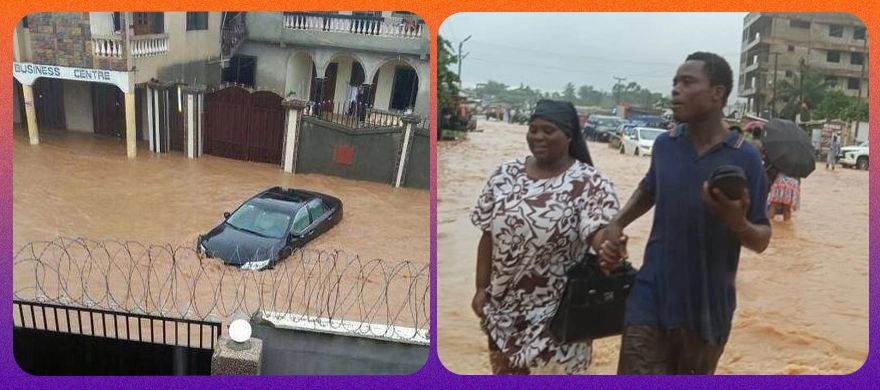
The heavy rains that began over Accra late on the night of 28th June, 2026, were traced back to a slow-moving storm system off the coast of Togo that swept over the Greater Accra, Volta, Eastern and Central Regions. The rains continued through to Monday, 29th June, 2026, triggering some of the worst flooding the capital has seen in years, including in areas that hadn't reported flooding in a while.
Some of the worst-hit corridors were parts of the N1 Highway, Apenkwa towards Tesano, the Accra–Kasoa stretch, Weija, Mallam, Achimota, Spintex, Atomic in Madina, Kaneshie, Darkuman Junction, portions of the Kwame Nkrumah Interchange, and several surrounding communities including Alajo, Circle, Odaw, Adabraka, Adenta and Lapaz. In low-lying neighborhoods, homes and shops were submerged, with residents moving belongings to safer ground as water levels rose.
Before Monday's morning rush hour even got underway, the floods had already submerged major roads, slowed traffic, and swept away vehicles and shop goods. The crisis was compounded when a fire broke out at the Odawna/Okaishie Rubber Market, near the Kwame Nkrumah Circle, despite the ongoing rainfall — flooding actually slowed down the firefighting response, as crews struggled to move equipment and logistics through the waters. An Assistant Divisional Officer interviewed on Adom FM confirmed that four fire tenders were deployed to keep the blaze from spreading while crews worked through the flooded streets.
Death toll
As of the latest update, at least 12 people have died as a result of the floods, according to official
records — though the figure climbed steadily through the day as rescue and recovery operations continued,
rising from an initial 4 confirmed deaths to 9, and now 12.
Among the dead are at least three to four
residents of Alajo, who were electrocuted after floodwaters made contact with electrical wiring inside their
homes; one victim had reportedly already been rescued but went back inside to retrieve a television and was
fatally shocked.
A fourth Alajo victim, a man believed to be in his 60s, was found along a nearby railway line. Officials
have cautioned that the toll could still rise as search-and-rescue work continues and as unconfirmed reports
from other communities are verified.
Government and emergency response
The Ministry of the Interior moved quickly with a public safety advisory, confirming that the Ghana Police Service, the Ghana National Fire Service, the Ghana Armed Forces, the National Disaster Management Organisation (NADMO), and other emergency response services had been deployed to monitor the situation, assist affected persons, manage traffic, and undertake rescue operations where required.
Interior Minister Mohammed Mubarak Muntaka addressed the public directly, urging people to avoid unnecessary movement and work from home where possible, warning that weather conditions could worsen. He advised motorists against driving through floodwaters and urged residents in safe locations to remain indoors until conditions improved, adding:
"If you are being submerged by floodwaters, call the emergency numbers and a rescue effort will be on the way."
⚠️ Helpline: NADMO can be reached on 0302 772395 or 0299 344030, or via WhatsApp on 055 160 9393. The Ministry of the Interior's general advisory also lists 112 as a shared emergency line that connects to NADMO, police, and fire services.
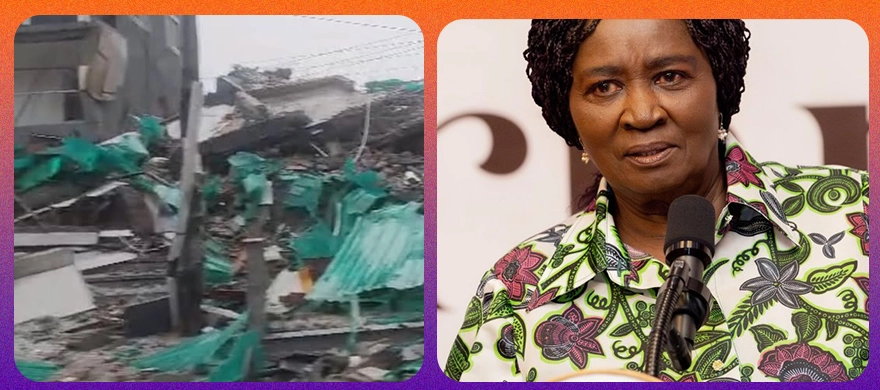
NADMO's response went beyond advisories: Emergency responders were deployed to affected communities to rescue trapped residents and assist those displaced by the floods, with rescue teams using boats and other equipment to evacuate vulnerable persons, including children, the elderly, and persons with disabilities, from submerged homes. Assessment teams were also dispatched to evaluate damage and coordinate relief efforts. Greater Accra Regional Minister Linda Obenewaa Akweley Ocloo additionally directed all Metropolitan, Municipal and District Chief Executives (MMDCEs) to move into affected communities with emergency response teams to intensify rescue operations.
The military launched a dedicated operation: the Ghana Armed Forces deployed personnel to several
flood-prone areas under an operation codenamed Operation Boafo, with troops stationed at strategic locations
including Klagon, Tse Addo and Dzorwulu.
The commanding officer of the 48 Engineer Regiment confirmed his team had already rescued several stranded
individuals who had reached out for help.
As a precaution, the Electricity Company of Ghana (ECG) and Ghana Grid Company (GRIDCo) temporarily shut
down power supply from the Mallam and Achimota primary substations after floodwaters affected the
facilities, contributing to outages across the city.
NADMO is also rolling out a longer-term tool: a mobile app that will let residents report flooding and
emergencies in local languages, for quicker response times. President Mahama reportedly conducted an aerial
inspection of the flood-hit areas as the scale of the disaster became clear.
Weather outlook
GMet warned the danger wasn't over. Senior meteorologist Frederick Cudjoe noted that
"the propagation of this rainstorm is very slow, so we anticipate continuous rains of varying intensities through to the afternoon."
Later that day, GMet issued a further alert that thunderstorms and rain would affect the southwestern parts of the country from afternoon into the evening, with northern Ghana also at risk later, and sea conditions rated rough as the rains intensified.
Underlying Causes
Minister Ocloo had previously flagged flood-prone communities — including Kaneshie, Alajo, Circle, Weija,
Madina, Adenta and Tema — for intensified monitoring, with ongoing desilting exercises and removal of
structures obstructing waterways.
GMet's own assessment shows how fragile the city's drainage has become: rainfall of about 30 millimetres can
now trigger significant inundation in many parts of the city, with June rainfall totals projected at 100–150
millimetres.
Residents and experts continue to point to poor drainage systems, indiscriminate waste
disposal, and rapid urbanisation as the structural drivers behind Accra's recurring flood disasters — and
are calling for stronger enforcement against building on waterways and improved early-warning systems to
prevent the next one.