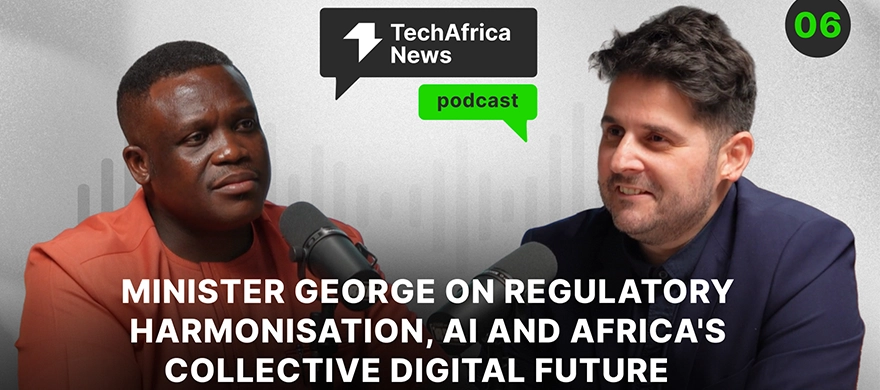
Ghana is sitting on an estimated 10 billion paper records, and the government wants to turn them into a
national asset before foreign AI companies find a way to take that value for free.
That's the core of what Sam George, Ghana's Minister for Communications, Digital Technology and Innovations,
said in comments carried by NewsGhana on July 16, 2026, from an interview on the TechAfrica News podcast
recorded around the Mobile World Congress in Barcelona.
His argument, in plain terms: Ghana's Public
Records and Administrative Division alone holds close to 10 billion analog records that need cleaning,
digitizing and structuring - and instead of letting big AI firms come in, "help" digitize that data, and
quietly walk away owning it, Ghana wants to control the process and set the price.
What Minister Sam George Actually Said
George's framing is that data is Africa's next major export, the same way gold, cocoa or oil have been. His
exact words, as reported: "Africa is sitting on the next big natural resource: data."
His reasoning holds up on paper. Africa accounts for roughly a quarter of the world's population and speaks
more than 2,000 languages, yet most leading AI models are trained overwhelmingly on Western datasets. That
mismatch is why AI tools consistently underperform on African languages and regularly misread how informal
African markets actually work - from trotro routes to susu contributions to market-day pricing that has no
Western equivalent.
George's warning is that if African governments don't build the local capacity to clean and structure their
own data first, foreign firms will offer to do it for them - and end up owning it. He called this "data
colonization."
The pitch sounds generous on the surface: a tech company offers free digitization in exchange for access.
The catch is that whoever controls the structured dataset afterward controls its value, and that's rarely
the country that generated the data in the first place.
The Ghana-Specific Plan Behind the Statement
This isn't just a talking point - there's an existing scaffolding the government is pointing to.
The One Million Coders programme is meant to train young Ghanaians in AI, cloud computing,
cybersecurity and data annotation - the exact skills needed to clean and structure 10 billion records before
anyone can sell access to them. Alongside it, the DigSmart initiative has reportedly already trained
close to 300,000 public sector workers in basic AI proficiency, according to the government's own figures
cited in the interview.
Ghana has also built a $250 million AI computing centre, which George says is intended to serve
innovators across the continent, not just Ghana. And separately, work is underway on large language models
trained specifically for African languages - an attempt to fix the underperformance problem at the source
rather than wait for Silicon Valley to get around to it.
On the governance side, George says every government ministry is now required to designate a technical focal
person for AI and data governance, which - if it's actually enforced - would embed this into daily
government operations rather than leave it as a one-off ministerial announcement.
Where the Numbers Need a Caveat
A few figures in George's comments deserve a flag rather than a straight repeat.
The 10 billion records figure is described as an estimate from the Public Records and Administrative
Division, not an audited count - worth noting given the scale of the claim. Similarly, George cited an
unnamed study projecting that AI could eliminate around 96 million jobs globally between 2025 and 2030
while creating about 132 million new ones.
No source, author or institution was named for that study in
the reporting available, so treat the specific numbers as attributed to George's remarks rather than an
independently verified projection. The broader point - that AI will both displace and create jobs - is
widely supported in labour economics literature, but the precise figures shouldn't be repeated as settled
fact.
It's also worth being upfront about timing: the remarks were made on a podcast recorded around the Mobile
World Congress in Barcelona, which several outlets place in early July 2026, but the comments only
circulated in Ghanaian media on July 16–17.
What This Actually Means for Ghanaians
Ten billion paper records means birth certificates, land documents, court filings, business registrations -
decades of physical paperwork sitting in government archives that most Ghanaians have personally dealt with
in one form or another. Anyone who has queued at the Lands Commission or waited months for a court document
knows exactly how disorganized these systems can be. Digitizing them properly isn't just an AI dataset play
- done right, it's the difference between spending a week chasing a land title and pulling it up in
minutes.
The uncomfortable question the coverage hasn't asked yet: who actually gets paid when this data is
eventually sold or licensed to AI companies, and does any of that value reach the citizens whose records
make up the dataset? A birth certificate or land record is personal information before it's a "natural
resource." George's data colonization framing protects the state's ownership claim, but it doesn't say much
about individual privacy protections, consent, or whether Ghanaians will ever see a cedi of whatever this
data eventually generates. Ghana's Data Protection Act, 2012 (Act 843) technically governs this kind of
activity, but the interview gave no detail on how a national data-monetization plan squares with individual
data protection rights.
What to Watch Next
It's whether a formal data monetization policy or legislation actually gets published, and whether it includes anything about individual privacy, consent, or revenue-sharing for citizens whose personal records are part of the dataset. Until that document exists, this remains a stated ambition, not a policy. Filladey will update this piece if the Ministry of Communications, Digital Technology and Innovations releases anything more formal.