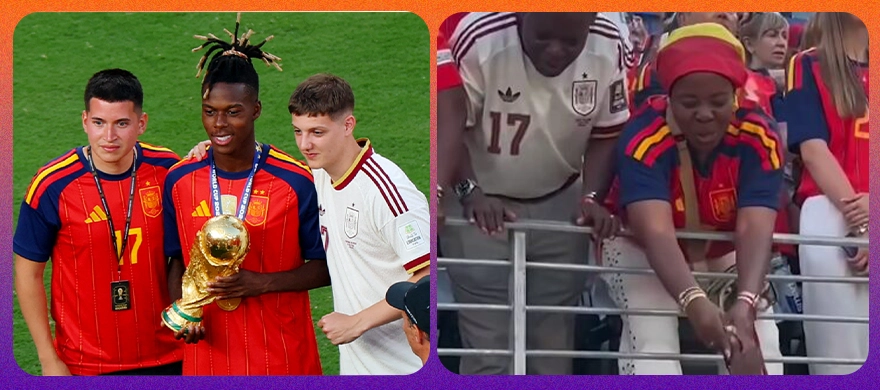
Nico Williams didn't start Sunday's World Cup final. He didn't even complete 90 minutes. But when Spain
needed
a match-winner against Argentina, it was his cross that found Ferran Torres for the goal that won Spain
their
second World Cup.
That single assist, delivered in extra time at New York/New Jersey Stadium, is why Williams's name is
trending
today - and why Ghanaians in particular have extra reason to care about a Spanish football story.
What Nico Williams actually did in the final
Spain beat Argentina 1-0 after 120 minutes, in a match that turned when Argentina's Enzo Fernández was
sent
off for a rough challenge on Pau Cubarsí. With Argentina down to ten men, Williams - introduced as a
substitute - burst down the left wing early in the second period of extra time and delivered the cross
Torres
finished to win the trophy.
He nearly had a goal of his own too. Williams put the ball in the net earlier in extra time, only for it to
be
ruled out after Mikel Merino was penalised for a foul on Nicolás Otamendi in the build-up. So the assist
stands as his defining moment of the tournament - not a bad consolation.
A World Cup that almost passed him by
Williams nearly didn't feature at all in the knockout
rounds. He picked up a muscular injury against Uruguay in the group stage that flared up badly enough to
keep
him an unused substitute through the wins over Austria and Portugal.
He finally returned off the bench against Belgium in the semi-final, entering in the 78th minute before
Merino
scored the winner minutes later. By his own admission, he still hadn't found his rhythm heading into the
final. He'd played just five matches and roughly 76 minutes total before Sunday, according to World Soccer
Talk's tournament tracker - a modest return for a player many expected to be Spain's starting winger.
That context matters. The assist wasn't the payoff of a dominant tournament. It was one big moment from a
player who spent most of the summer managing an injury from the bench.
The Neymar dedication
After the final whistle, Williams surprised plenty of people by dedicating Spain's triumph to Brazilian forward Neymar, whom he called his "idol." It's an unusual gesture for a title-winning moment - most players thank family, coaches, or teammates first. Neither Williams nor the Spanish federation had elaborated further on the dedication as of Sunday night, so the full story behind it remains unclear.
Where does Ghana come in
Nico Williams was born in Pamplona
to
Ghanaian immigrant parents who crossed into Spain in 1994. His older brother, Iñaki Williams, plays
professionally too - except Iñaki suits up for Ghana's Black Stars, not Spain.
And Iñaki wasn't just eligible for Ghana this cycle - he was actually on the pitch. Carlos Queiroz named him
in Ghana's 26-man squad for this same World Cup, and Iñaki featured (in a rotational role, benched for the
Croatia and Panama games per Bolavip US) as Ghana reached the Round of 32, their best World Cup run since
2010.
So on the same global stage, in the same summer, one Williams brother helped Ghana make history while the
other set up the goal that won the whole tournament for Spain. That's not a footnote - that's the actual
story
most non-Ghanaian outlets have buried under six paragraphs of Torres and Rodri coverage.
It's also not unprecedented in football, but it is rare at this level. Brothers representing different
countries at the same World Cup finals is the kind of split-family drama that usually only shows up in
transfer sagas - not trophy moments.
Player stat trackers don't fully agree on Williams's tournament numbers. Some pre-final databases had him
down
for zero assists across the group stage and knockouts combined, while post-final trackers list one assist
total - the Torres cross - after 108 minutes across six appearances. That discrepancy is likely just a
timing
issue between when each site last updated, but Filladey isn't treating either number as final until FIFA's
post-tournament technical report is published, which typically takes a few weeks.