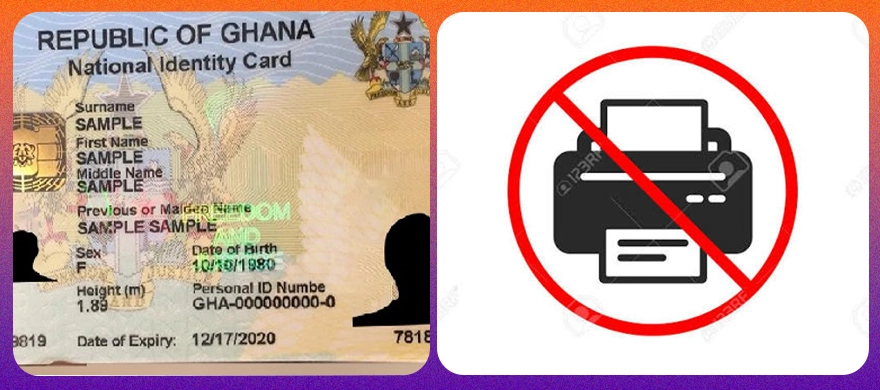
Stop handing over photocopies of your Ghana Card. As of Wednesday, July 15, 2026, doing so for any
transaction is officially a criminal offence in Ghana, and the institution that takes it can be fined
too.
The National Identification Authority confirmed the change through Executive Secretary and CEO Wisdom Deku,
who announced that an amendment to the National Identity Register Regulations, 2012 (L.I. 2111) had just
been gazetted. From now on, the only legal way to verify a Ghana Card is through biometric authentication -
not a photocopy, not even the old "let me just look at it" method. Banks, mobile money agents, employers,
landlords, telcos - all of them are covered.
What the new rules actually say
Under the amended L.I. 2111, it is now an offence to photocopy or visually inspect a Ghana Card to
confirm someone's identity during a transaction. Biometric verification through the NIA's Identity
Verification Platform is the only method the law recognises going forward.
The penalties are steep enough to get compliance officers moving. Institutions that flout the rule face
fines between 500 and 2,000 penalty units, which works out to roughly GH¢6,000 to GH¢24,000 at the current
GH¢12 penalty unit rate. Individuals face smaller but still painful fines, ranging from 50 to 500 penalty
units - about GH¢600 to GH¢6,000.
Deku says organisations that haven't yet connected to the NIA's verification platform should start the
onboarding process now, before enforcement catches up with them. He's also indicated that the sector
minister will brief the public in the coming days on how implementation and compliance will actually work on
the ground.
This didn't come out of nowhere
Ghana has been building toward this for over a year. Back in June 2025, the NIA's Head of Corporate
Affairs, Williams Ampomah Emmanuel Darlas, was already telling Ghanaians to resist banks demanding
physical copies of their cards, insisting the Ghana Card number alone was enough for verification.
Around the same period, the Bank of Ghana was quietly instructing banks to drop the practice
altogether.
By September 2025, the NIA signalled it was done asking nicely and would amend the regulations to
introduce actual sanctions. The following month, the Bank of Ghana issued a revised Supervisory Guidance
Note requiring banks to rely solely on the Ghana Card, the Non-Citizen Identity Card, or the Refugee
Identity Card for customer verification, alongside mandatory biometric liveness checks for digital
account opening.
What changed this week is scope. Everything before this was mostly aimed at banks. The gazetted
amendment extends the biometric-only rule to every organisation that verifies identity using the Ghana
Card - landlords, telecom vendors, employers doing background checks, hostels, event organisers, all of
it.

What this means for Ghanaians
If you've ever been asked to leave a photocopy of your Ghana Card at a SIM registration centre, a job
interview, or a hostel front desk, that request is now illegal on the institution's part. You're within
your rights to refuse and ask for biometric verification instead.
The catch is that not every organisation is hooked up to the NIA's verification platform yet. That gap
between the law taking effect and businesses actually having the technology to comply is where friction
is going to show up first - expect some confusion at smaller institutions, rural bank branches, and
informal-sector businesses that don't have card readers or app access. The NIA itself seems to know
this, which is likely why Deku is pointing organisations toward onboarding immediately rather than
assuming everyone is already compliant.
There's also a data-protection angle nobody's really spelling out yet. A Ghana Card photocopy in the
wrong hands has historically been a soft entry point for identity fraud - mobile money SIM swaps and
loan scams built on stolen ID details have been a recurring problem in Ghana. Killing the photocopy
habit should, in theory, close that door. Whether it actually reduces fraud complaints in the coming
months is something worth tracking, not assuming.
The NIA boss's name appears slightly differently between reports - "Wisdom Yayra Koku Deku" in some
outlets and "Wisdom Kwaku Deku" in others. The role and statement are consistent across every source;
only the middle name varies, likely a transcription issue rather than a factual dispute.
The sector minister's promised briefing on implementation, and whether the NIA gives smaller businesses
a grace period to onboard onto the verification platform before fines start landing. Enforcement details
- who polices this and how - haven't been made public yet, and that's the part that will decide whether
this rule actually bites or quietly gets ignored like a lot of directives before it.