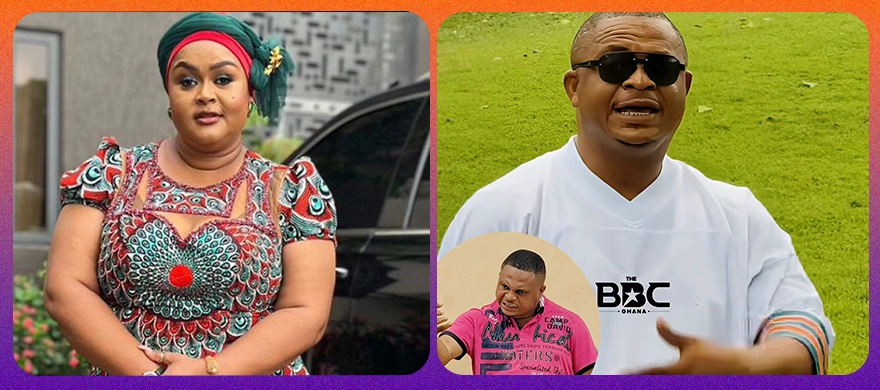
The Abrewa Mafia Connection
Vivian Jill Lawrence needs little introduction to any Ghanaian.
A household name in the Kumawood film
industry, she has spent decades building a reputation as one of Ghana's most recognisable and beloved
actresses.
Kwabena Boakye, on the other hand, gained widespread popularity through his association
with
her on the Abrewa Mafia comedy series - a YouTube production that leaned heavily on the comedic contrast
between the two personalities.
In the show, Kwabena Boakye played a grandson figure to Vivian Jill's
grandmother character, and audiences loved every bit of it.
For many fans, theirs appeared to be a warm mentorship and a mutually beneficial professional
relationship.
The series gave Kwabena Boakye significant exposure, introduced him to a broader
audience,
and helped establish his brand as a content creator.
As media personality Abro would later put it,
Vivian Jill gave him the platform that made him visible to Ghana.
Kwabena Boakye Speaks out in viral videos
In early June 2026, the entertainment landscape shifted dramatically when Kwabena Boakye posted a series
of
emotional videos that quickly went viral across TikTok and Facebook.
Speaking from what appeared to be
a
remote location, he opened up about what he alleged were years of neglect, betrayal, and exploitation at
the
hands of people he had trusted in the industry - with Vivian Jill and popular comedian Dr. Likee at the
centre of his grievances.
His core complaint against Vivian Jill was that despite his loyalty and contribution to the Abrewa Mafia
brand, she had stopped treating him with the respect he felt he deserved.
He alleged that whenever he
tried to raise personal problems with her - especially in public - she would ask him to call her later,
and
then never pick up the phone when he did.
He felt she only reached out when she needed his
participation
in content creation, turning the relationship entirely transactional on her end.
He also alleged that a recent interview Vivian Jill had granted contained negative remarks about him,
which
he described as deeply hurtful given his years of dedication to their shared project.
The financial
dimension was equally stark: he claimed he was paid a flat rate of GH₵700 per shooting day on the Abrewa
Mafia series, a figure he considered grossly inadequate for the work he put in.
In further videos, he
revealed that when he needed Vivian Jill to appear on his own independent movie set, she charged him
GH₵10,000 for just a few days - a stark contrast, he argued, to the loyalty he had given her for free.
In one particularly charged moment, Kwabena Boakye said directly: "You used me like a donkey."
He went
further, calling out what he described as a pattern of selfishness towards colleagues in the industry,
including the sacking of a movie director and a failure to extend support to others whose careers were
intertwined with hers.

Divided Opinions
The videos triggered a wave of commentary across Ghana's entertainment circles, with public opinion
sharply
divided.
Veteran media pundit Abro was among the most direct critics of Kwabena Boakye's public outburst.
He
argued that the actor should count his blessings rather than bite the hand that fed him, pointing out that
his recognition largely came through Vivian Jill's platform.
Abro also questioned whether Kwabena
Boakye
shared any of his own fan earnings with the actress, suggesting the grievances revealed a sense of
entitlement.
He even mused that the actor may not have been in his best state of mind when he recorded
the videos.
Social commentator Appiah Stadium, however, took a different position.
He publicly declared his
support
for Kwabena Boakye, noting that he had personally gone out of his way to defend Vivian Jill during an
earlier controversy - involving a dispute with an NDC women's organiser over a school feeding programme
contract - and had never received acknowledgement for it.
His frustration added another dimension to
the
conversation around how Vivian Jill managed relationships within her circle.
Among fans on social media, the reactions were equally split.
Some felt Kwabena Boakye was justified
in
expressing his hurt, with many noting that GH₵700 a day for content that built a large YouTube following
seemed inadequate.
Others urged both parties to resolve things privately, with some pointing out that
Kwabena Boakye's continued use of affectionate terms for Vivian Jill - even in his most heated complaints
-
showed that his feelings were rooted in genuine hurt rather than malice.
The Legal Route and the Settlement
As the controversy intensified, the matter escalated beyond public commentary.
The dispute eventually
moved into formal legal territory, culminating in a court-mediated agreement.
On the night of Thursday, June 25, 2026, Kwabena Boakye posted what he described as a duplicate copy of a
settlement agreement on his Facebook page, signalling that the matter had been resolved.
The document,
dated June 22, 2026, outlined the key terms of the resolution: Vivian Jill agreed to pay Kwabena Boakye a
sum of GH₵80,000 as compensation for his years of work on their collaborative projects.
As part of the
agreement, the actor would refrain from making further public statements against her.
Additionally,
arrangements were reportedly put in place for him to travel back to France, with visa preparations said to
be handled by Vivian Jill.
In his post, Kwabena Boakye was emphatic that this was not charity.
He stressed that he had not gone
begging but had simply received what he had always rightfully been owed for his contributions.
The
framing was important to him - this was about dignity and recognition, not a handout.
A Ghanaian Industry Reckoning
he Vivian Jill and Kwabena Boakye saga resonates well beyond celebrity gossip.
It speaks to a pattern
that many in Ghana's entertainment industry know all too well: the informal, unwritten agreements that
govern creative partnerships, the power imbalances between established stars and emerging talents, and the
thin line between mentorship and exploitation.
In an industry where many collaborations are sealed with a handshake rather than a contract, younger or
less
prominent creatives often find themselves in vulnerable positions.
When those relationships sour, they
have little formal recourse - which may explain why Kwabena Boakye chose the court of public opinion
before
pursuing a legal settlement.
The GH₵80,000 resolution may have closed this particular chapter, but the conversation it sparked about
fair
pay, transparency, and professional respect within Kumawood and Ghana's digital entertainment space will
likely echo for much longer.
For both Vivian Jill and Kwabena Boakye, the hope now is that they can
move
forward - if not to their former closeness, then at least to a mutual respect that honours what they built
together.