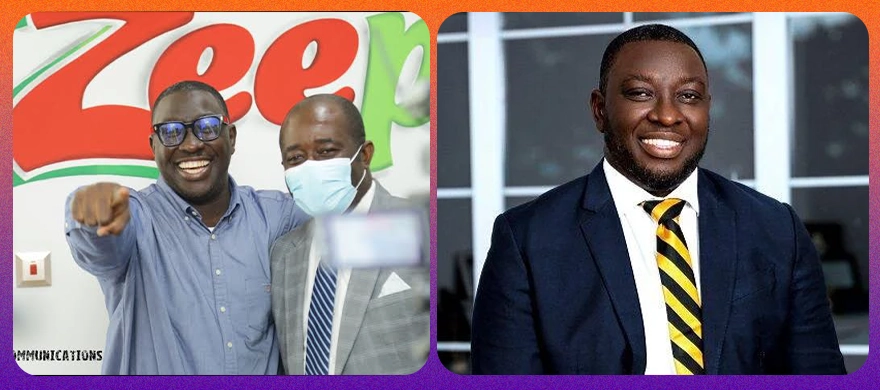
Police and court officials stormed the Airport Residential Area home of Zeepay founder and CEO Andrew
Takyi-Appiah on July 6, 2026, seizing the property and towing away vehicles to enforce a High Court judgment
ordering him and his company to pay businessman Michael Yusuf more than $11.6 million.
The seizure is the enforcement stage of a ruling delivered nearly three months earlier, on April 16, 2026,
when Justice Afi Agbanu Kudomor of the High Court's Commercial Division granted summary judgment in favour
of
Yusuf against Zeepay Ghana Limited and Takyi-Appiah personally.
The Judgment
The court ordered Zeepay and Takyi-Appiah to jointly pay Yusuf $11,585,753, €8,500, and GH¢1.4 million,
with
interest running from the date of judgment and legal costs of GH¢500,000.
According to the ruling, Yusuf had deposited funds with Zeepay for onward transfer to people he designated.
Those transfers were not completed. In reviewing the evidence — including deposit records and correspondence
between the parties — the court found that a significant portion of the money had been paid not into
Zeepay's
corporate accounts, but into Takyi-Appiah's personal mobile money wallet.
Zeepay's legal team, led by O.K. Osafo-Buabeng, applied to have Takyi-Appiah removed as a defendant, arguing
the claim was a company matter and not his personal responsibility. Justice Kudomor rejected the
application,
ruling that the transfer of funds into his personal wallet made him "a proper party to the instant
action" and
holding him jointly liable with the company. The court also found that Zeepay and Takyi-Appiah had "not
been
able to raise a reasonable defence to the instant action to be allowed to contest Yusuf's claims against
them on the merits."
The Appeal and Enforcement
Zeepay and Takyi-Appiah appealed the ruling and applied for a stay of execution to halt enforcement pending
the outcome. On June 24, 2026, a Court of Appeal panel comprising Justices Anthony Oppong, Francis Koffie,
and
Yaw Oppong dismissed the application, finding that Zeepay and Takyi-Appiah had filed no depositions or
evidence showing Yusuf would be able to refund the money should the appeal ultimately succeed.
That ruling cleared the way for enforcement officers, accompanied by police, to move on properties linked to
Zeepay and its CEO. Beyond the Kofi Annan Street residence, reports indicate Zeepay's Cantonments office has
also been placed under seizure.
The Yusuf case is a civil matter. No criminal charges have been filed against Takyi-Appiah in connection
with
it as of publication.
Other legal and regulatory pressure on Zeepay
The Yusuf judgment is not Zeepay's only active dispute:
- Obsidian Achernar Ltd, a Bank of Ghana-licensed financial services firm, filed a winding-up petition
against
Zeepay at the High Court's Commercial Division in June 2026, seeking to have the company liquidated over
an
unpaid balance of $1,223,250 arising from a 2024 foreign exchange and working capital agreement.
The petition states Zeepay settled the cedi portion of the debt and a payment plan proposed by Takyi-Appiah in March 2025, but not the outstanding dollar balance. Zeepay had not filed a public response to the petition as of early July 2026. - The Central Bank of Barbados suspended the licence of Zeepay's subsidiary, Zeemoney (Barbados) Limited,
in
May
2026, citing concerns over financial condition, governance, and regulatory compliance.
Zeemoney subsequently applied for voluntary winding-up of its four Barbados branches rather than resume operations. Customers were told they would be informed "in due course" about recovering funds held in Zeemoney wallets. - Zeepay's Chief Financial Officer, Nana Ntim Asamoah, resigned in February 2026. A resignation letter reportedly copied to the Economic and Organised Crime Office and the Bank of Ghana cited difficulties completing audits due to concerns over the reliability of information provided.
Neither Zeepay nor the Bank of Ghana had issued a detailed public statement addressing the full scope of
these
matters as of this report. Zeepay has previously asked the public to treat media coverage of the Yusuf case
with caution while its appeal remains before the Court of Appeal.
All figures in this report are
accurate
as
of July 12, 2026, and are subject to change as the appeal and the winding-up petition proceed.

Company Background
Founded by Takyi-Appiah in 2014, Zeepay built its name on cross-border remittances and mobile money,
reporting
operations in more than 20 markets and, by its own account, more than 10 million transactions worth over $3
billion processed in 2023 alone.
It became the first Ghanaian-owned company to receive an Electronic
Money
Issuer licence from the Bank of Ghana in April 2020 and raised roughly $23–26 million in equity funding
since
inception, alongside debt financing including an $18 million facility in 2025.
The company had previously faced a two-week suspension of its forex licence by the Bank of Ghana in 2023
over
violations of the Foreign Exchange Act, a matter it resolved.
The current combination of the Yusuf
judgment,
the Obsidian Achernar petition, and the Barbados licence suspension represents a wider scale of legal and
regulatory exposure than the company has previously faced.
What's next
The Court of Appeal has yet to rule on the substance of Zeepay and Takyi-Appiah's appeal against the Yusuf judgment. The winding-up petition brought by Obsidian Achernar is pending before the High Court's Commercial Division. Neither the Bank of Ghana nor Zeepay has stated publicly whether local customer funds held in Zeepay wallets are affected by the company's legal exposure.